The humble skillet flatbread known as Terlí Pisía (Τερλί Πισία) or Pítes sto Tigáni (Πίτες στο Τηγάνι) belongs to a deep and intertwined culinary tradition that spans the southern shores of the Black Sea — from the Pontic Greek villages of northeastern Anatolia to the Turkish, Laz, and Armenian kitchens that shared the same landscapes and ingredients. In the mountainous Pontos region, where wood-fired ovens were rare and stone hearths more common, flatbreads cooked on hot surfaces were the everyday bread of choice. Families used a satz (saj in Arabic, saç in Turkish, and satsi in Pontic Greek)— a domed iron griddle placed over an open flame — to bake everything from paper-thin unleavened breads to thicker, butter-enriched doughs. Bread was not merely a staple but a medium for resourcefulness: the same dough could be fried, baked, layered, or dried for later use, depending on the day’s needs.
A 2022 ethnographic study of Pontic Greek cuisine in the Journal of Ethnic Foods confirms that grain-based foods, particularly breads, pies, and pasta, formed the backbone of the Pontic diet. Among the dishes listed are perek (περέκ) — a layered pastry akin to Turkish börek and Greek tiropita — and pishía (πιςία), small dough rounds cooked with butter and often served sweet with honey or sugar. These dishes reflect the adaptive genius of rural households that turned simple dough into multiple textures and meals through technique rather than ingredients.
Perek, Pishía, and the World of Pontic Flatbreads
The perek is perhaps the best-known of Pontic pastries — thin sheets of dough rolled by hand and cooked briefly on the satz before being layered with butter or cheese. The sheets could be stored dry for months, making them an early example of preserved convenience food. In some communities, these sheets were rehydrated with milk or butter and stacked into rich pies, while in others, they were fried as individual breads. The pishía, by contrast, were humbler: pieces of risen or unleavened dough cooked directly on the pan or griddle, sometimes in butter, sometimes plain. Their texture ranged from pliable to flaky, and their uses from breakfast bread to dessert. Some versions were brushed with honey; others were eaten alongside soup or cheese. The very name pishía (πιςία) evokes the sizzling sound of dough hitting a hot surface — a word of onomatopoeic intimacy that survives in Pontic dialects to this day.
Across the Black Sea coast, similar foods appeared in neighbouring traditions: Turkish gözleme (stuffed pan bread), yufka (thin, dry flatbread), and börek (layered pastry) share the same rolling, folding, and buttering techniques. Armenian cooks made jingalov hats (flatbreads with herbs), while Laz and Georgian kitchens contributed filled breads like khachapuri, where dough, dairy, and heat combined in ever-evolving forms.
The Pontic Genius of Improvisation
What ties all these foods together is a technique-based intelligence — a way of cooking that maximized flavour, texture, and preservation without waste. Butter, clarified fat, and dairy gave richness; folding and layering created flakiness; the absence of ovens encouraged ingenuity with pans and griddles. Terlí Pisía embodies precisely this spirit. Its buttery layers, folded dough, and stovetop cooking echo the multi-layered pies of the Black Sea highlands, but it also stands as a distinct Pontic expression — a cross between bread and pastry, hearty yet delicate. The word terlí itself (from Turkish terli, “moistened” or “sweated”) may refer to the dough’s soft, pliant quality once enriched with butter. Today, Terlí Pisía continues to be made in Pontic homes and diaspora kitchens, often shared at community gatherings or served alongside cheese, honey, or thick yogurt. In its simplicity, it preserves an unbroken connection to a broader Black Sea world of domestic craftsmanship — where bread was not merely baked, but shaped, folded, and given character by hand. When you roll and fry these breads in a modern kitchen, you’re echoing an ancient way of combining flour, butter, and flame — one that has travelled from the hearths of the Pontos to the frying pans of Vancouver, Melbourne, and Thessaloniki alike.
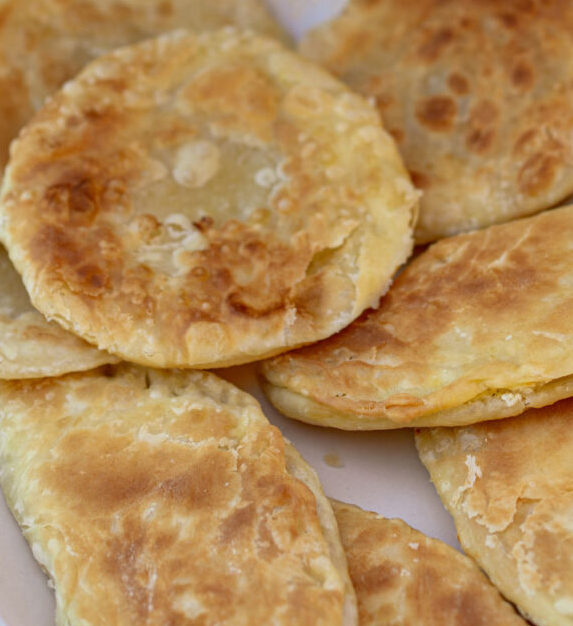

Terlí Pisía
Preparation Time: 25 minutes
Chilling Time: 30 minutes
Cook Time: 2–3 minutes per bread
Total Time: About 1 hour 10 minutes
Servings: 8 flatbreads
You will need
600 g all-purpose flour
200 ml fresh milk
200 ml water
1 tablespoon olive oil
1 teaspoon baking powder
1 teaspoon salt
150 g melted butter, plus extra for brushing
Instructions
Make the dough: In a large mixing bowl, combine the flour, milk, water, olive oil, baking powder, and salt. Mix until a soft dough forms, then knead for a few minutes until smooth and pliable. It should not stick to your hands.
Divide and shape: Lightly flour your work surface. Turn the dough out and divide it into 8 equal pieces (about 110 g each). Roll each piece into a small ball.
Roll out the dough: Dust your surface again and roll one ball into a thin circle using a rolling pin — the thinner, the flakier.
Layer with butter: Brush the rolled dough generously with melted butter. Fold the two opposite edges inward, leaving a 2-finger-wide gap in the centre. Using a knife, make a small cut lengthwise down the middle of the gap (not all the way through). Fold one end over to form a square, then continue folding from the other side until you have a neat square parcel of layered dough. Repeat with all pieces.
Chill: Cover the folded dough squares with plastic wrap and refrigerate for 30 minutes to rest.
Roll again: Remove one dough square at a time and gently roll it out again into a round about 25–28 cm wide — just enough to fit your frying pan.
Butter and layer: Brush both sides of each rolled flatbread lightly with melted butter. Stack them on a plate, brushing butter between layers so they don’t stick.
Cook: Heat a non-stick skillet or frying pan over medium heat (no extra oil needed — the butter in the dough is enough). Cook each flatbread for 2–3 minutes per side, turning occasionally until both sides are golden brown and lightly crisped.
Serve: Enjoy warm, straight from the pan! They’re delicious on their own or with savoury fillings, cheese, or a drizzle of honey.
For an even richer flavour, sprinkle the warm breads with a touch of sea salt or brush them with garlic butter just before serving.
 the kitchen sorcerer