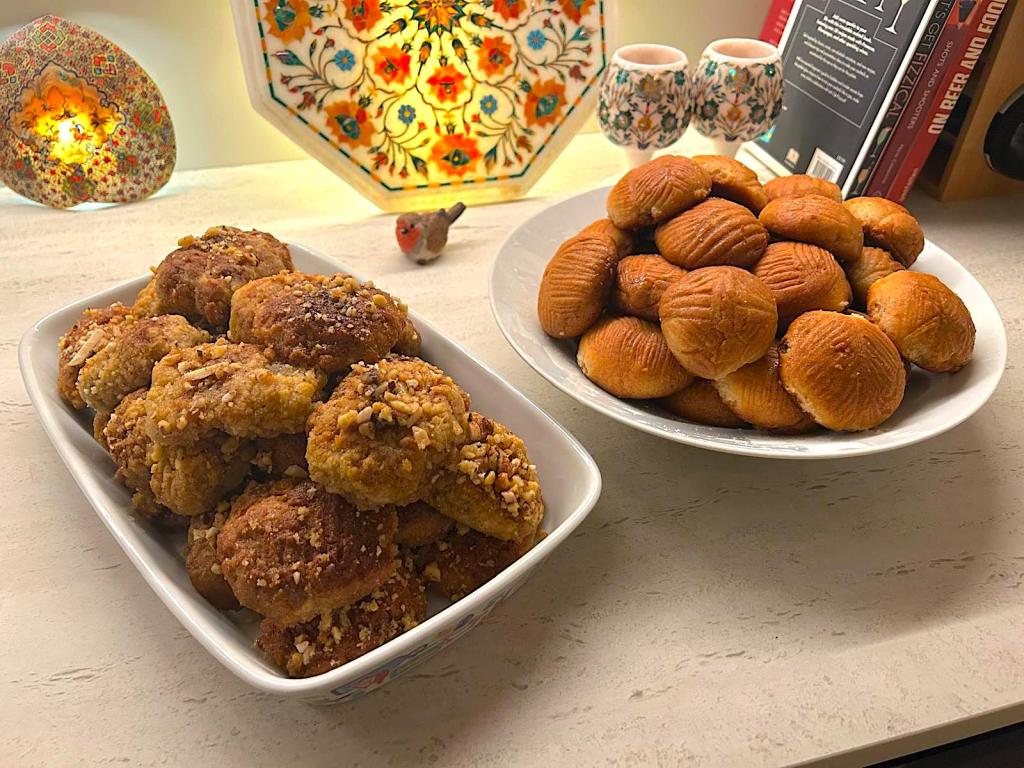
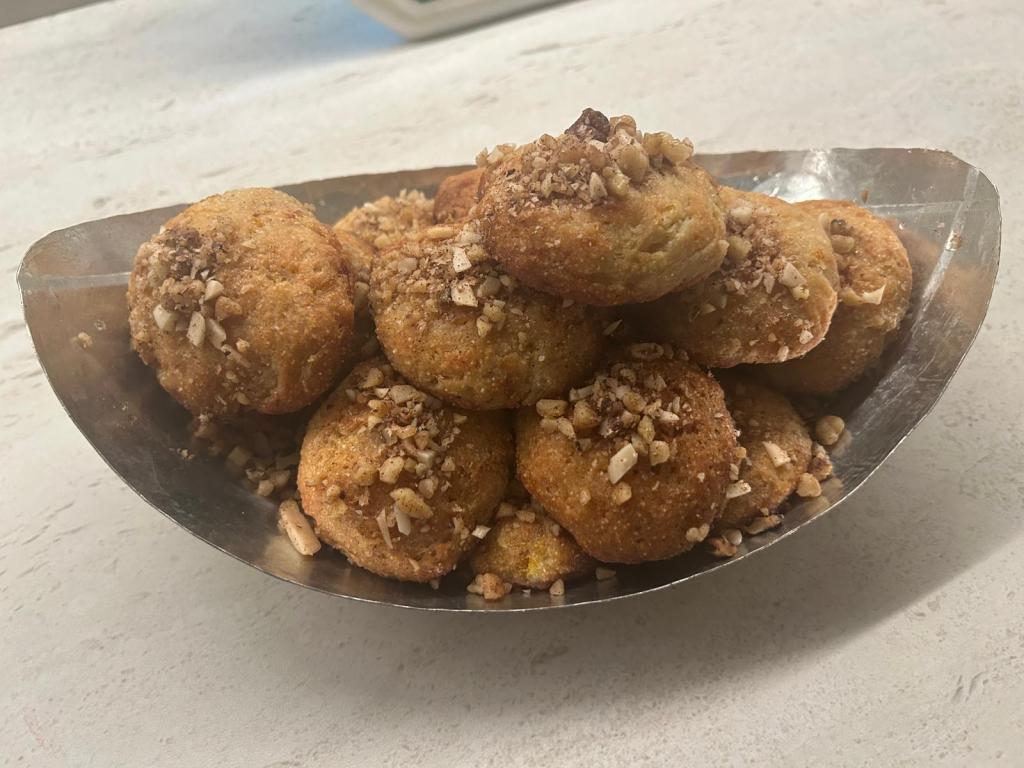
Melomakarona are the quintessential Greek Christmas sweet: crisp-edged, tender-crumbed cookies soaked in honey syrup and finished with fragrant cinnamon and walnuts. Unlike pastries glazed with sugar alone, melomakarona combine olive oil, citrus, spice, and syrup-and-honey sweetness in a way that reflects the wider Mediterranean palate where honey, spices, and nuts have long been key players in celebratory baking.
Although now a hallmark of Christmas tables throughout Greece, melomakarona (μελομακάρονα) trace their roots to the medieval spice routes and early domestic baking traditions of the Byzantine and Ottoman eras, where sugar and honey were both luxury and thus considered to be a blessing. Their Aegean rise was natural: the abundance of olive oil, local citrus, walnuts, and citrus-scented syrups found close cousins across Anatolia and the Levant, from Turkish revani (semolina cake in syrup), or şekerpare (syrupy semolina cookies), to Middle Eastern basbousa and qatayef, or the Lebanese hareeseh or Egyptian harissa (semolina & syrup), or, finaly, the nut-enriched honey cakes and pastries of the Caucasus region. But the classic Greek form remains distinguished by its olive-oil–enriched dough, orange aroma, and honey-cinnamon finish.
The provenance of melomakarona most likely has a circuitous history originating in the μακαρία (makaría) of the classical and Hellenistic period. Μακαρία was a simple barley-based food offered at funerary rites and memorial meals. It was not a cake in the modern sense but a ritual grain dish, usually a porridge or bread, connected to the μακάριοι (makárioi) the “blessed dead.” Although barley, was the ritual grain of antiquity, in late Antiquity and Byzantium, these grain offerings evolved into κόλλυβα (kóllyva), made with boiled wheat, nuts, pomegranate and sweeteners, preserving the symbolic link between grain, memory, and blessing. At the same time, Byzantine kitchens developed a rich tradition of honeyed doughs and nut-filled pastries for religious feasts and festivals. In the Ottoman era, the spread of sugar and syrup-based desserts reshaped these older traditions into the aromatic, soaked pastries of the Eastern Mediterranean. Melomakarona emerged in the 18th century from this fusion: a modern Greek Christmas sweet that carries in its name the memory of ancient ritual grain foods, while in its form belonging to the Aegean–Levantine world of honey, spice, and syrup. The name of the cookie itself combines méli (μέλι, “honey”) with Makaroneia, rooted in makaria/μακαρία, which is the root of the French macaron.
Prep Time: 25 minutes
Bake Time: 30 minutes at 350F
Syrup Time: 10 minutes
Total Time: ~1 hour 15 minutes
Yield: ~40–50 cookies
You will need
400 g all-purpose flour
100 g semolina (fine)
150 ml olive oil (or light olive oil)
80 ml fresh orange juice
Zest of 1 orange
50 ml sugar syrup (from the syrup you will prepare)*
1 tsp ground cinnamon
½ tsp ground clove
1 tsp baking powder
1 tsp baking soda
100 g sugar
For the honey syrup
500 g sugar
300 ml water
200 g honey
Peel from 1 orange
1 cinnamon stick
For garnish
150–200 g walnuts, coarsely chopped. I also add some finely chopped dried dates in the mix
Extra ground cinnamon
Instructions
Prepare the honey syrup: In a pot, combine the water, sugar, orange peel, and cinnamon stick. Warm gently and bring to a boil. Once boiling, reduce heat and simmer 10 minutes. Remove from heat, add the honey, stir until dissolved, and let the syrup cool to warm.
Make the dough: In a large mixing bowl, mix together the flour, fine semolina, baking powder, and baking soda.
In a separate bowl, combine olive oil, orange juice, orange zest, sugar and cinnamon. Gradually add the wet into the dry and mix with a wooden spoon or your hands until you form a soft, sticky dough. Knead lightly in the bowl until smooth; do not overwork as you will end up separating the oil from the rest of the dough.
Shape the cookies
Preheat oven to 180°C (350°F).
Take small pieces of dough (about a walnut’s size) and roll lightly into ovals. Traditional shapes are elongated but slightly flattened. Gently press with the flat side of a fork the top of the cookies to create a parallel line pattern. Place the shaped pieces on a parchment-lined baking tray with a little space between them.
Bake: Bake for 25–30 minutes, or until they are a warm golden colour. They should not brown deeply – melomakarona are meant to stay on the pale side.
Syrup the cookies: Remove the hot cookies from the oven and, while still warm, dip them quickly into the warm honey syrup. Let them soak for a moment – don’t leave them submerged too long or they’ll collapse – then place on a cooling rack over a tray to drain excess syrup.
Garnish and serve: Once drained but still moist, sprinkle coarsely chopped walnuts and a dusting of cinnamon over the cookies.
Serve at room temperature. These cookies improve in flavour over a day or two as the syrup fully permeates the dough.
Serving & Storage
Melomakarona are traditionally served during Christmas and New Year, on their own, with Greek coffee, sweet wine, or tea. Keep in an airtight container at room temperature; they remain moist and flavourful for up to a week. Pair with kourabiedes for a classic holiday cookie platter – melomakarona for syruped sweetness, kourabiedes for snowy richness.
 the kitchen sorcerer