I first encountered malfatti while teaching at the University of Siena during the spring terms between 2003 and 2005. Like many dishes in Tuscany, it did not present itself as something extraordinary. It appeared in modest trattorie and home kitchens, often without explanation, simply as part of the seasonal rhythm of cooking. What drew my attention was precisely this lack of spectacle. The dish seemed unassuming, yet clearly required a degree of care that was not immediately visible. At the time, I began asking around for a recipe. What I found was less a standardized method and more a set of practices – variations shaped by habit, local preference, and the quality of ingredients available. That variability is not incidental; it is constitutive of the dish itself.
What Are Malfatti?
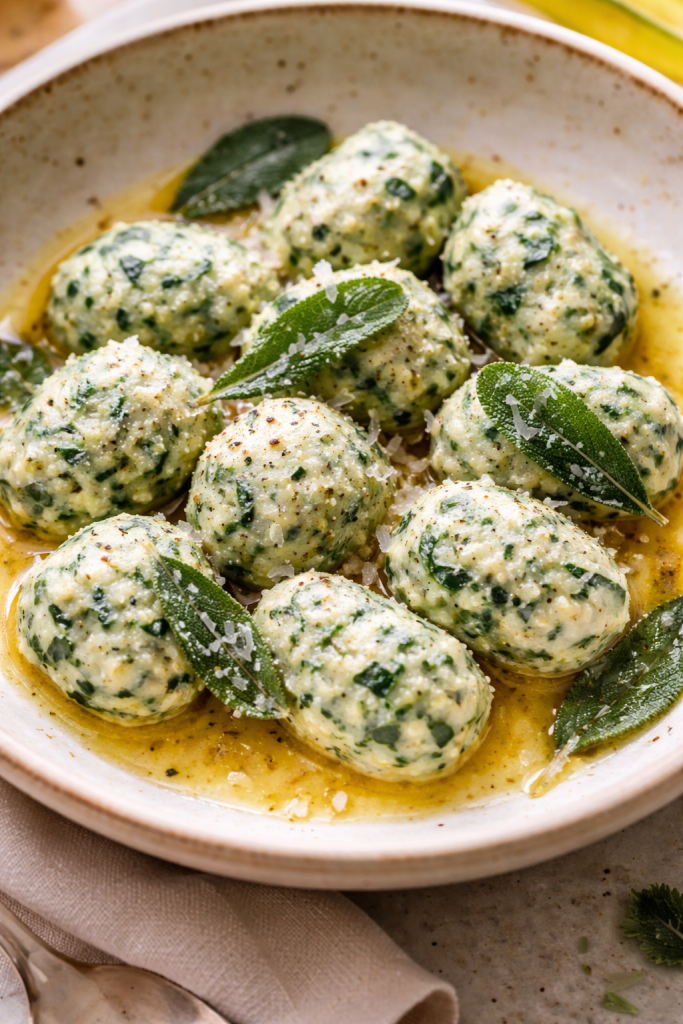
The name malfatti translates loosely as “badly made,” a reference to their irregular, hand-formed shape. In Florence, the same preparation is often called gnudi—“naked”—because it resembles the filling of ravioli without the pasta casing. The distinction is regional rather than substantive.
At its core, malfatti consist of ricotta, spinach, egg, and Parmigiano, brought together into soft dumplings and cooked gently in water. Their apparent simplicity is deceptive. The success of the dish depends less on technique in the conventional sense and more on judgment—especially in managing moisture and texture.
Cucina Povera and Historical Context
Cucina povera (literally “poor kitchen”) refers to a broad set of culinary practices that developed across Italy—especially in rural regions—under conditions of scarcity. It is less a fixed cuisine than a logic of cooking: how to produce nourishing, satisfying food from limited means.
Malfatti belongs to the broader tradition of cucina povera, a mode of cooking shaped by scarcity but defined by resourcefulness. In this context, ingredients were rarely selected for abundance or luxury. Instead, they were repurposed: ricotta from leftover whey, greens that grew easily and abundantly, stale bread or minimal flour used sparingly.
This culinary logic can be traced back several centuries. Early modern Italian sources, including sixteenth-century cookbooks, contain recipes for simple dumplings made from basic ingredients – flour, breadcrumbs, or cheese – indicating a long-standing practice of forming and boiling mixtures of available materials. While the specific ricotta-and-spinach version appears to have developed later, particularly in central Italy, it clearly belongs to this longer lineage.
What is notable is that dishes such as malfatti were not codified in professional kitchens but transmitted through domestic practice. Their continuity relies less on written recipes than on repetition and adjustment across generations.
Core principles of cucina povera
At its heart, cucina povera is structured around a few consistent principles:
- No waste: Ingredients are reused, reworked, and extended. Stale bread becomes soups (ribollita) or salads (panzanella). Vegetable scraps are incorporated rather than discarded.
- Seasonality: Cooking follows what is available locally and at a given time of year. There is minimal reliance on preservation beyond basic techniques.
- Simplicity of ingredients: Dishes typically rely on a small number of components—grains, legumes, greens, dairy byproducts.
- Transformation over abundance: The emphasis is on technique and judgment—how to make something out of almost nothing.
- Local variation: There is no single cucina povera; each region develops its own repertoire depending on ecology and history.
Historical context
Cucina povera emerged from necessity, particularly among peasants, labourers, and rural households from the medieval period through the early 20th century. In these contexts:
- Meat was rare and often reserved for special occasions
- Dairy products like ricotta were byproducts of cheese-making
- Bread was central and never discarded
- Cooking took place within households rather than professional kitchens
Unlike elite culinary traditions—codified in courtly or urban cookbooks—cucina povera was transmitted orally and practically, through repetition rather than formal recipes.
Typical ingredients
While varying regionally, the following ingredients recur:
- Bread (often stale)
- Legumes (beans, chickpeas, lentils)
- Polenta or grains
- Leafy greens (spinach, chard, wild herbs)
- Ricotta and other simple cheeses
- Olive oil
- Small amounts of cured meat (when available, often for flavour rather than substance)
Examples of cucina povera dishes
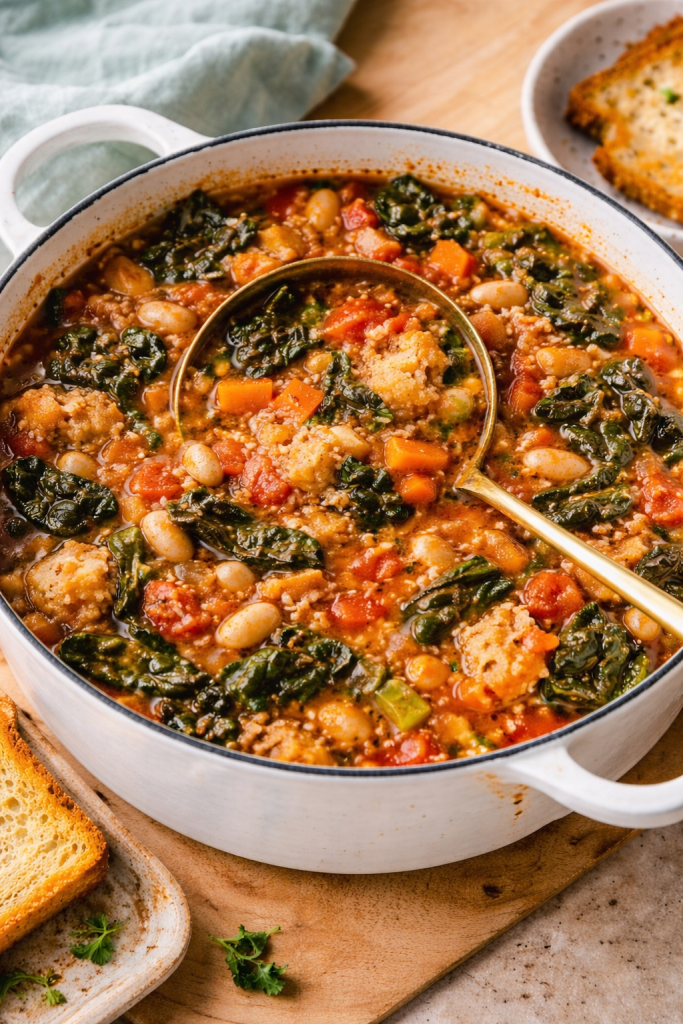
- Ribollita (Tuscany) – bread and vegetable soup, reheated (“reboiled”) over days
- Panzanella (Tuscany) – salad of stale bread, tomatoes, onions
- Malfatti / gnudi (Tuscany) – ricotta and spinach dumplings
- Polenta (Northern Italy) – cornmeal porridge, often paired with minimal accompaniments
- Pasta e ceci (Central/Southern Italy) – pasta with chickpeas
These dishes are unified not by ingredients alone but by their economy and adaptability.
Cucina povera challenges the assumption that culinary value depends on rarity or expense. In cucina povera, value emerges from care, judgment, and transformation
Working Toward a Recipe
When I attempted to reproduce malfatti outside Italy, I found that the central difficulty lies in controlling water content. Ricotta varies significantly depending on how it is produced and stored, and spinach retains more moisture than expected even after cooking.
Early attempts tend to fail in predictable ways: the dumplings break apart in the water, or they become dense through the addition of excessive flour intended to stabilise them. The balance is delicate. The mixture must hold together, but only just.
Over time, a workable approach emerges – one that respects the structure of the dish without over-correcting it.
Recipe: Malfatti with Butter and Sage
Ingredients
For the malfatti:
- 3 cups fresh spinach
- 1 cup whole milk ricotta, well drained
- 1 egg
- ½ cup finely grated Parmigiano-Reggiano
- A tiny pinch of freshly grated nutmeg
- Salt and black pepper
- ¼ cup semolina flour (plus extra for dusting)
For the sauce:
- 100 g unsalted butter
- 10–12 fresh sage leaves
- Additional Parmigiano to serve (I sometimes prefer the slight sweetness of Pecorino Sardo)
Method
Cook the spinach in lightly salted water until fully wilted. Drain it thoroughly, then press out as much moisture as possible. This step is critical. After squeezing, chop the spinach finely.
In a bowl, combine the spinach with the ricotta, egg, Parmigiano, nutmeg, salt, and pepper. Add a small amount of semolina flour—just enough to help bind the mixture. The texture should remain soft.
Dust a tray with semolina. Shape the mixture into small, irregular dumplings using your hands or spoons. Lightly coat each piece in flour and place them on the tray. Refrigerate for at least one hour to allow them to firm up.
Bring a large pot of salted water to a gentle simmer. The water should not boil aggressively. Cook the malfatti in batches; they are ready when they rise to the surface, after approximately two to three minutes.
Meanwhile, melt the butter in a pan and add the sage leaves. Allow the butter to take on a light golden colour and a nutty aroma. Remove from heat.
Transfer the cooked malfatti directly into the butter and sage, turning them carefully to coat. Serve immediately with grated Parmigiano.
Final Observations
Malfatti illustrates a broader principle within Italian cooking: that simplicity is not the absence of technique, but its concentration. There are few ingredients and few steps, but each one matters. The dish does not tolerate approximation well, yet it also resists rigid standardisation.
In that sense, it remains closely tied to the conditions in which it developed—local ingredients, embodied knowledge, and a cuisine shaped as much by constraint as by creativity.
 the kitchen sorcerer