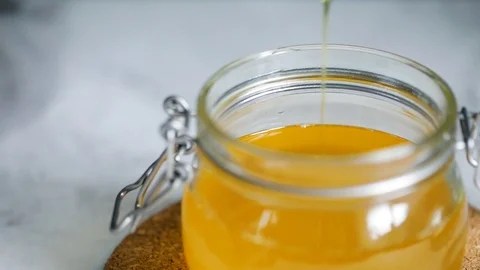
Some recipes call for clarified butter not merely for technical reasons, but because of what it offers: clarity, control, and depth. I still remember the first time I tried to make eggs over high heat with regular butter. I was in a rush, the pan was too hot, and the butter began to brown and smoke almost immediately. The eggs came out with a bitter edge, flecked with burnt milk solids. Later, Stefano, a chef friend of mine and housemate when I lived in Canterbury in England, laughed gently and said, “Butter is great, but only when you treat it properly. If you are going to turn up the heat, you need to clarify it first.” At the time, I didn’t quite understand what that meant, but I soon learned that butter, as we buy it, is an emulsion of water, fat, and milk solids—and that by removing the water and solids, you are left with pure butter fat: clean, golden, and stable under high heat.
Clarified butter doesn’t just make cooking easier; it transforms the flavour and texture of food. Because the milk solids are removed, there’s nothing left to burn, so the butter can handle temperatures up to around 232°C (450°F)—ideal for frying, sautéing, or roasting without smoking up the kitchen. It also offers a clean, neutral taste, free from the toasted or nutty notes that browning brings. For sauces, fish, or eggs, it gives you control, richness, and elegance without overpowering the dish. It keeps longer, too—refrigerated or even at room temperature, if made and stored properly—since there is no water left to encourage spoilage.
Then there is ghee, which I came to love through a different story. A friend’s mother, visiting from India, would make ghee on slow Sunday afternoons. She never used a thermometer or timer—just her eyes and nose. As the butter melted and simmered gently on the stove, the apartment filled with a rich, nutty scent. She would tilt the pan, watch the colour deepen, then strain the golden liquid into a clean jar, leaving the browned milk solids behind. Ghee is essentially clarified butter that has been cooked a bit longer, allowing those solids to caramelize and infuse the fat with a deeper, slightly sweet aroma. It is more than just a cooking medium—it carries memory, culture, and warmth. Unlike butter, it doesn’t need refrigeration, and it’s naturally free of lactose and casein, which makes it a good option for people with dairy sensitivities.
Making clarified butter at home is simple and satisfying. Begin with unsalted butter in a small saucepan, set over low heat. Do not stir, boil, or agitate the pan—just let the butter melt slowly and watch what happens. As it melts, you’ll notice the milk solids starting to float to the surface, forming a delicate foam, while the water begins to separate and sink to the bottom of the pan. Sometimes the solids will bubble up from below, riding on steam. Once the butter is fully melted and a clear golden layer of fat has formed between the top foam and the cloudy bottom, you can begin skimming the surface gently with a ladle or slotted spoon. These skimmed solids can be saved for another use—they are full of flavour and can be added to soups, rice, or even spread on toast. When the top is clear, carefully pour or ladle the pure butter fat into another saucepan or container, being sure to leave behind the water and any sediment at the bottom.
If you want to make ghee, follow the same process but allow the butter to cook a little longer. Keep the heat low and patient. Eventually, the milk solids will sink to the bottom of the pan and start to brown. You will smell the change before you see it—a warm, toasty fragrance that is both familiar and comforting. When the fat turns a rich amber and the solids have browned but not burned, remove the pan from the heat and strain the ghee through cheesecloth or a fine sieve into a clean jar. A friend dips a curry leaf in buttermilk as soon as she switches off the flame, and puts it inside the hot ghee. This process, she tells me, stops the ghee from further becoming darker and burnt, and makes the residue settle down. The result is a shelf-stable cooking fat with a deep, aromatic character that works beautifully in everything from roasted vegetables to curries, from baked goods to rice dishes.
Both clarified butter and ghee are quiet transformations—an everyday ingredient made extraordinary by attention and time. They remind us that cooking, at its best, is not just about recipes but about watching, listening, and letting things evolve. And in a small way, they invite us to slow down, take care, and find delight in the alchemy of the ordinary.
 the kitchen sorcerer