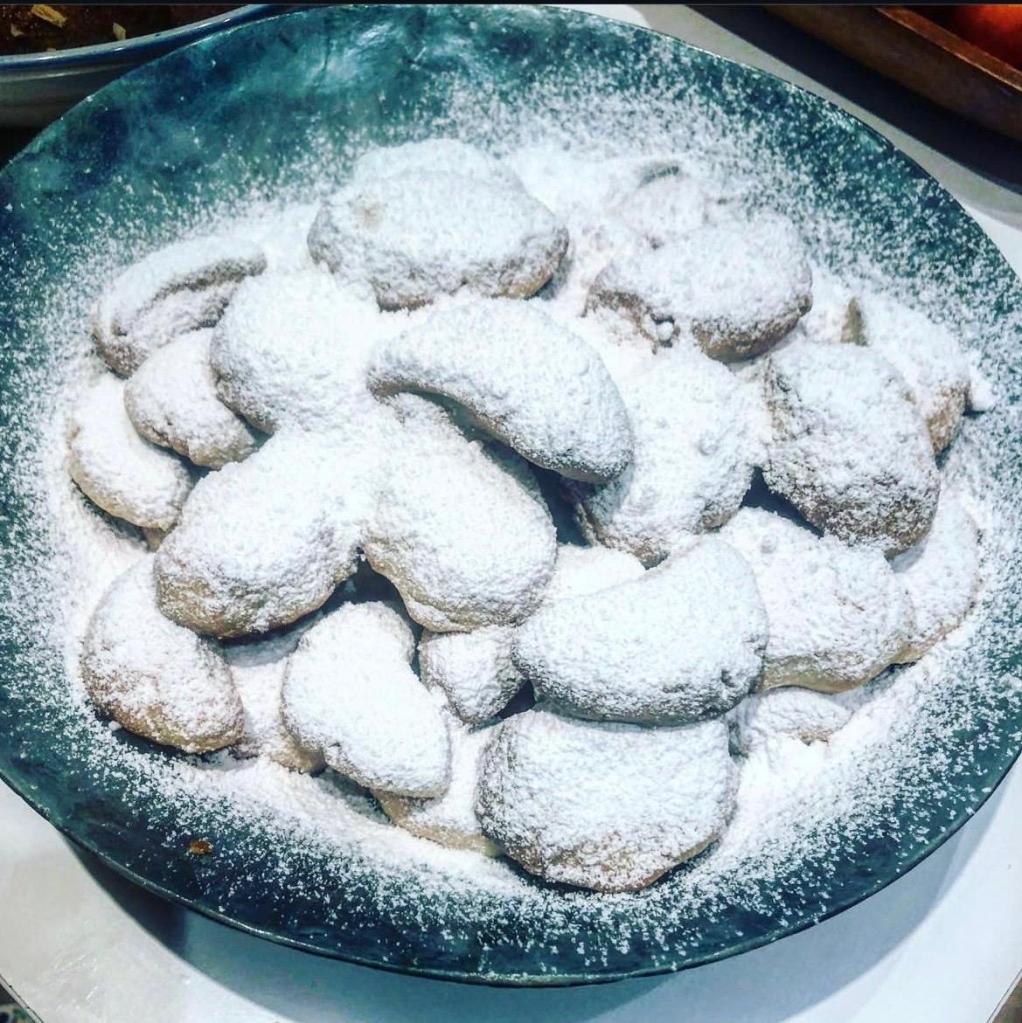
Few festive sweets are as deeply woven into the winter ritual of the Greek world as kourabiedes: buttery almond shortbreads dusted lavishly with a snowfall of icing sugar. Their crumbly texture, perfumed with butter and citrus, signals the arrival of Christmas across Greece and the Aegean.
Although now considered quintessentially Greek, the kourabie (from the Turkish kurabiye, ultimately linked to Persian ghorabieh) belongs to a broader family of almond shortbreads spanning Anatolia, the Caucasus, and the eastern Mediterranean. The Kavala kourabie, famous for its half-moon shape and ultra-fine texture, reflects the culinary exchanges of the late Ottoman period, especially between Asia Minor Greeks and their Turkish neighbours.
Across the Aegean, Christmas tables feature entire “constellations” of festive iced or syruped cookies—melomakarona, kourabiedes, isli, amygdalota, and islander almond biscuits—from Chios to Crete. Each region adapts the formula through local ingredients: Chios adds mastiha, the Cyclades fold in citrus, Cappadocians scent their dough with rose or orange blossom water.
This version, fragranced with orange blossom water (others prefer rosewater but I find orange blossom water subtler yet aromatic) and enriched with peeled, lightly toasted almonds, evokes the Aegean’s maritime freshness while honouring the delicate texture that makes kourabiedes a winter essential.
Cuisine: Greek & Asia Minor
Prep Time: 20 minutes
Bake Time: 20–25 minutes
Cooling & Dusting: 30 minutes
Total Time: ~1 hour
Yield: 35–45 cookies, depending on shape
You will need
For the kourabiedes
- 250 g unsalted butter, softened but still cool
- 100 g icing sugar
- 1 egg yolk
- 1 tsp vanilla extract or 1 sachet vanilla sugar
- 1 tbsp orange blossom water
- 80 g peeled almonds, lightly toasted and coarsely chopped
- 350–380 g all-purpose flour
- 1 tsp baking powder
- Pinch of salt
For finishing
- 300–400 g icing sugar for dusting
- A little extra orange blossom water (optional)
Instructions
Beat the softened butter with the icing sugar for 8–10 minutes on medium-high speed until very pale, fluffy, and mousse-like. This step is essential for the trademark crumbly texture.
Mix in the egg yolk, vanilla, and orange blossom water. Beat briefly to combine. Fold in the toasted peeled almonds. They should remain coarse enough to provide texture.
In a separate bowl, mix flour, baking powder, and salt. Add gradually to the butter mixture. You want a dough that is soft but not sticky—adjust flour slightly if needed.
Form into balls, crescents, or small domes. Place on a baking tray lined with parchment paper. Leave some space between them as they expand slightly.
Bake in a preheated oven at 180°C (350°F) for 20–25 minutes, or until very lightly golden at the edges. Kourabiedes should remain pale.
Cool for 10 minutes. Spray them with a bit of orange blossom water (just to create a key for the icing sugar) and, while still warm, lightly sprinkle with icing sugar. Once fully cool, place them on a tray and sift a thick layer of icing sugar over the top until they look like fresh snow.
The kourabie is part of a centuries-old lineage of shortbread-like almond confections found across the eastern Mediterranean. Its linguistic and culinary origins trace back to the Ottoman world, where versions of kurabiye were made with almonds, clarified butter, and fragrant waters. Over time, Greek regional adaptations — especially after the 1923 population exchanges — shaped the cookie into its modern form.
The Kavala Kourabie
Perhaps the most famous regional variant, the kourabies Kavalas features highly aerated dough, fine almond powder, and a crescent form. It reflects the strong Asia Minor influence on northern Greek pastry-making, particularly the techniques brought from Smyrna and Cappadocia.
Christmas Tradition
In Greek homes, kourabiedes are inseparable from Christmas and New Year. Alongside melomakarona and diples, they form the core festive triad — one syruped, one buttery, one celebratory and dusted in white. Their pure snowy coating has long been associated with purity, blessing, and prosperity for the coming year.
Aegean Almond Traditions
Almond-based cookies are a hallmark of Aegean island pastry culture:
- Cyclades: citrus-scented almond biscuits
- Chios: mastiha-infused amygdalota
- Samos & Lesvos: rosewater or orange-blossom shortbreads
- Asia Minor Greeks: embroidered or stamped cookies (e.g., isli) reflecting Ottoman artistry
Kourabiedes sit among these as the most festive of all — delicate, fragrant, and celebratory.
 the kitchen sorcerer